


Why Combine Layers and Replacement Pullets on One Farm?
A commercial egg business does not depend only on the number of hens laying today. It also depends on whether the next flock will be ready at the right time. Without a replacement plan, an aging layer flock can cause a sharp fall in output while the farm waits for new birds to reach production age.
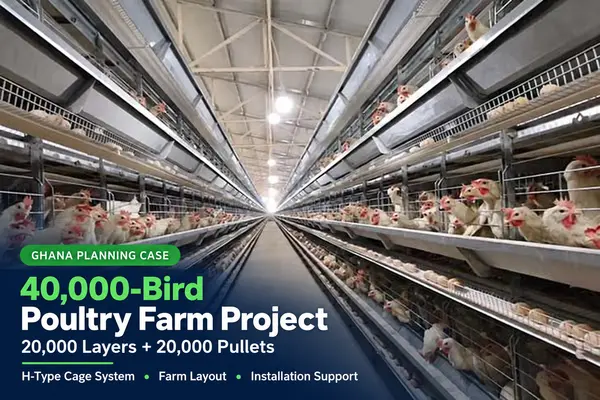
This 40,000-bird planning example combines approximately 20,000 commercial layers with about 20,000 replacement pullets. Separate houses allow the two groups to receive different feeding, lighting, ventilation and management programs while shared infrastructure reduces unnecessary duplication.
The central objective is production continuity: prepare the next flock without disrupting the current egg-producing house.
Project Structure at a Glance
The reference plan uses one layer house and one pullet house, both based on four-tier H-type cage systems. The preliminary capacities are slightly above the round target to match complete cage sets and practical row lengths.
- Layer house capacity: approximately 20,160 birds
- Pullet house capacity: approximately 21,200 birds
- Production zones: one dedicated layer house and one dedicated pullet house
- Shared systems: water storage, power backup, internal roads and farm security
- Separate management: feeding schedules, lighting programs and flock-health controls
These figures are planning references. Final cage quantities and house dimensions must be recalculated for the selected cage model, site boundaries and local building requirements.
The Layer House Is Designed Around Egg Flow
The layer house should support uniform feeding, dependable drinking, regular manure removal and careful egg transfer. Automatic egg collection becomes especially valuable because production from 20,000 hens creates a large, time-sensitive handling task.
Core Layer-House Systems
- H-type layer cages with appropriate bird density
- Automatic feed delivery from silo to cage rows
- Nipple drinking lines with filtration and pressure control
- Manure belts beneath each cage tier
- Longitudinal egg belts and a collection point
- Ventilation, cooling, lighting and environmental controls
The egg route should end in a clean grading or storage area. It should not cross the manure-discharge route or the vehicle path used for feed delivery.
The Pullet House Is Designed Around Uniform Development
Pullets need controlled access to feed and water as their body size changes. Cage configuration, lighting and environmental settings should support uniform growth and prepare the birds for transfer into the layer system.
A pullet house should not be treated as a smaller copy of the layer house. It has different cage partitions, feeding adjustments and management targets. Staff need safe access to inspect bird distribution, drinker operation and feed availability on every tier.
Prepare Birds for the Production System
Using compatible cage and equipment concepts can make later transfer easier. Pullets should be familiar with nipple drinkers and organized feeding before they enter the layer house. A planned transition reduces disruption at the point when the flock is approaching sexual maturity.
Create a Flock Calendar Before Ordering Equipment
Equipment capacity should support the farm’s flock calendar. Work backward from the target replacement date and include brooding or rearing time, vaccination, transfer, cleaning and downtime between groups.
A simple calendar should show:
- Arrival or placement date for pullets
- Growth and vaccination milestones
- Expected transfer window
- Layer-house depopulation date
- Cleaning, disinfection and maintenance period
- Start of production for the replacement flock
If the calendar requires both houses to operate at full load simultaneously, utilities and labor must be sized for that peak rather than for an average month.
Size Shared Utilities for Simultaneous Demand
Two-house farms can share infrastructure, but shared does not mean undersized.
Feed Storage and Distribution
Layers and pullets may use different feed formulations. The design should prevent accidental mixing and allow deliveries without entering restricted bird areas. Separate silos or clearly isolated conveying paths may be required.
Water Supply
Storage, pumps and treatment equipment must meet the combined hot-weather requirement of both houses plus sanitation and cooling. House-level meters help managers detect abnormal consumption quickly.
Electricity and Backup Power
The emergency system should support critical ventilation and water functions in both houses at the same time. Staggered motor startup can reduce peak generator demand, but it must be engineered rather than assumed.
Separate Clean and Dirty Traffic
The biggest management advantage of a planned site is the ability to control movement. Staff, feed trucks, egg vehicles, manure equipment and visitors should not all follow the same route.
The farm can be divided into:
- A controlled entrance and staff hygiene zone
- Clean feed-delivery and egg-dispatch routes
- Restricted bird-house service areas
- A dirty route for manure and mortality handling
- An isolation area away from routine traffic
Where possible, assign tools and protective clothing to each house. Movement should generally progress from younger or higher-health-status birds toward older birds, followed by cleaning and disinfection procedures.
Plan Flock Transfer as a Dedicated Operation
Moving approximately 20,000 pullets requires more than available labor. The route, timing, transport modules, house preparation and emergency arrangements should be written into the farm plan.
Before Transfer
- Confirm layer-house cleaning and disinfection are complete
- Test drinkers, feeders, lights and ventilation under operating load
- Prepare the receiving cages and verify access on every tier
- Choose cooler hours for movement when climate conditions are hot
- Brief teams on bird handling and biosecurity separation
The goal is to reduce time without water, prevent overcrowding during movement and allow the flock to settle quickly.
Reserve Expansion Space Without Weakening Phase One
A phased site may add more houses after the first production cycle proves the market. Roads, drainage, power distribution and water storage should therefore have a defined expansion path.
However, investors should avoid buying oversized equipment everywhere simply because expansion is possible. Identify which assets are economical to oversize now—such as the main transformer route, central water line or road width—and which are better added with the next house.
Management Indicators to Track
The value of a layer-and-pullet system appears in operating data. Track at least:
- Pullet body-weight uniformity
- Daily water and feed use by house
- Mortality and culling rate
- Age at transfer and age at first egg
- Hen-day egg production
- Egg breakage and downgraded eggs
- Manure moisture and house ammonia indicators
- Electricity and generator use
These measures show whether the two-house plan is producing a smooth transition or merely moving the production gap.
What Investors Can Learn From This Layout
A 40,000-bird farm divided between layers and pullets uses capacity to protect future output, not only current output. The design should connect flock scheduling with equipment, utilities, traffic flow and biosecurity.
When both houses are planned together, the farm can prepare replacement birds under controlled conditions, coordinate transfer dates and reduce the risk of a long production interruption. That operational continuity is often more valuable than maximizing the number of laying hens in the first phase.