

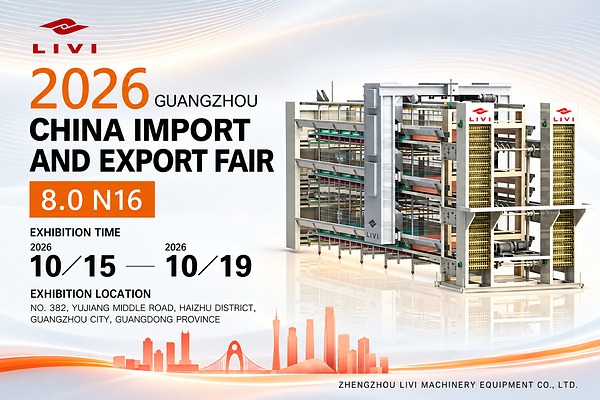

Meet LIVI Machinery at the 140th Canton Fair
Commercial poultry farmers, investors, distributors and agricultural project developers can meet LIVI Machinery during Phase 1 of the 140th China Import and Export Fair in Guangzhou.
- Exhibition: 140th Canton Fair, Phase 1
- Dates: October 15–19, 2026
- Booth: Hall 8.0, N16
- Focus: layer, pullet and broiler equipment plus integrated poultry-farm planning
The fair is an opportunity to compare more than cage samples. Buyers can discuss how feeding, drinking, manure removal, egg collection and environmental control should fit a real farm capacity and poultry-house layout.
Bring a Project Brief, Not Only a Price Request
The most productive equipment discussion starts with operating conditions. A quotation based only on total bird quantity may overlook building limits, climate, labor, power and the investor’s expansion plan.
Prepare a one-page project brief containing:
- Country and farm location
- Bird type: layers, pullets or broilers
- Initial and future bird capacity
- Number and dimensions of existing or proposed houses
- Local summer temperature and humidity
- Available power, voltage and outage frequency
- Water source and storage capacity
- Preferred automation level
- Target construction or production date
If drawings, site photos or a land plan are available, bring clear copies with dimensions. Remove private personal information that is not necessary for technical evaluation.
Define the Business Objective First
Two farms with the same capacity can require very different systems. One investor may prioritize low initial expenditure; another may need maximum output per square meter; a third may need automation because skilled labor is limited.
Before the meeting, rank these objectives:
- Capital-cost control
- Labor reduction
- High stocking capacity
- Egg-handling quality
- Manure and odor management
- Climate resilience
- Future expansion
This ranking helps the technical team explain where automation produces the greatest practical return and where a simpler configuration may be sufficient.
Know Which Equipment Systems Must Work Together
At Booth N16, poultry buyers can review the main systems used in a commercial farm.
Cage System
A-type layer cages can suit small and medium commercial farms that want flexible automation. H-type cages use multiple vertical tiers and are commonly selected for medium and large projects requiring higher building utilization and centralized automation.
Ask how the selected model affects row quantity, building height, ventilation and maintenance access—not only birds per set.
Automatic Feeding and Drinking
Feed silos, conveyors and traveling feeders should deliver feed consistently across all rows and tiers. Drinking lines require filtration, pressure regulation and accessible flushing points. Buyers should discuss feed-delivery vehicle access and water quality at the same time as internal equipment.
Manure Removal
Belt manure systems remove waste from beneath cage tiers and transfer it outside the house. Confirm discharge direction, operating frequency, external conveyor arrangement and the final manure-storage or treatment plan.
Egg Collection
Automatic egg belts reduce repetitive carrying and can connect multiple rows to a central line. Ask about belt speed, transfer points, collection capacity, breakage-control features and the connection to grading or packing.
Environmental Control
Fans, cooling pads, air inlets, sensors and intelligent controllers must be sized for the building, cage density and climate. A list of components is not a ventilation design; request the calculation basis and proposed equipment positions.
Questions Every Buyer Should Ask at the Booth
Use the meeting to test whether a supplier is thinking about the whole farm.
Layout and Capacity
- How was the final cage quantity calculated?
- What clear internal dimensions are required?
- Where are cross passages, service areas and equipment rooms?
- Can the design reserve a practical expansion path?
Utilities and Risk
- What is the connected electrical load and motor-starting demand?
- Which systems require emergency power?
- How much daily and peak water capacity is required?
- Which spare parts should be stored locally?
Delivery and Installation
- What is included in the equipment scope?
- How will goods be packed and loaded for shipment?
- What foundations and openings must be completed before arrival?
- What installation guidance, commissioning and operator training are provided?
Operating Cost
- How many workers are normally required at the proposed automation level?
- Which components need routine replacement?
- How are feed loss, egg breakage and manure-belt tracking controlled?
- What maintenance schedule is recommended?
Avoid Four Common Exhibition-Purchasing Mistakes
Comparing Only the Cage Price
A lower cage price can be offset by extra freight, missing accessories, incompatible house dimensions or higher labor requirements. Compare complete scopes and operating consequences.
Finalizing the Building Too Early
Columns, door positions and roof height can conflict with cage rows, conveyors and ventilation. Coordinate the equipment layout before structural drawings are frozen.
Ignoring Backup Systems
High-density houses depend on ventilation, water and controls. Backup power, alarms and emergency operating procedures belong in the project budget from the beginning.
Buying for Today’s Capacity Only
If expansion is likely, reserve road access, utility routes, manure handling and central egg-collection capacity. A phased design should state what can be expanded and what must be replaced.
What to Request After the Meeting
A useful post-fair proposal should include more than a product catalogue. Ask for:
- Preliminary cage and house layout
- Equipment list with quantities and functions
- Bird-capacity calculation
- Utility requirements
- Loading and shipment estimate
- Installation responsibility matrix
- Recommended spare-parts list
- Warranty and after-sales process
- Items excluded from the supplier’s scope
Review these documents as one system. A missing conveyor, control panel or discharge arrangement can affect the operation of several other components.
Visit Hall 8.0, Booth N16 With Your Farm Data
LIVI Machinery will present commercial poultry equipment and integrated farm-planning capabilities at the 140th Canton Fair Phase 1 from October 15 to 19, 2026.
Farm owners and investors who bring capacity targets, house dimensions and utility information can use the meeting to move from a general product inquiry toward a workable poultry-farm configuration. The clearer the project inputs, the more useful the layout, equipment scope and next-step quotation can become.