


A Low Price Does Not Always Mean a Lower Project Cost
Two poultry equipment quotations can show the same bird capacity and very different prices. The difference may come from cage specifications, automation scope, material quality, shipping terms, installation support or items excluded from the offer.
Commercial farm buyers should compare quotations line by line. A clear proposal helps the investor estimate the complete project cost and prevents expensive surprises after the poultry houses are built.
Confirm the Design Basis First
Require Project-Specific Inputs
Every quotation should state the information used to prepare it. At minimum, confirm:
- country and project location;
- layer, pullet or broiler production;
- target and designed bird capacity;
- poultry-house quantity and dimensions;
- cage model, tiers, rows and sets;
- birds per cage or compartment;
- open, semi-open or enclosed house design;
- climate and ventilation assumptions;
- voltage and frequency;
- required automation level.
If the supplier has not received the house dimensions or climate conditions, the offer should be treated as preliminary. Equipment quantities and ventilation requirements may change after the final drawings are approved.
Check Cage Specifications Beyond the Model Name
“A-type cage” or “H-type cage” is not a complete specification. Compare cage dimensions, wire diameter, galvanizing method, frame design, tier quantity, door arrangement, trough material and the number of birds per set.
For layer projects, review both the A-type layer cage system and the H-type layer cage system against the farm’s capacity, labor plan and desired automation.
Ask the supplier to provide a row layout showing cages, passages, service areas and equipment at both ends of the house.
Separate Included Equipment From Optional Equipment
Compare the Scope System by System
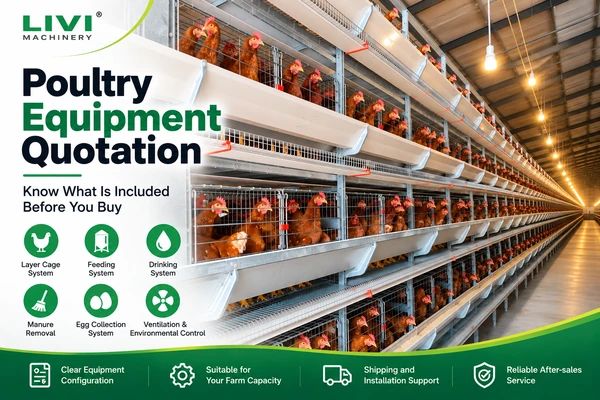
A useful quotation should organize the scope by system. Typical sections include:
- cage structure and accessories;
- automatic or manual feeding;
- nipple drinking and water-line components;
- manure removal;
- egg collection for layer farms;
- environmental control;
- feed silos and conveying;
- electrical control cabinets;
- installation tools and spare parts.
Do not assume a system is included because it appears in a product photograph. Require a quantity and specification for every major component.
Review the Feeding Scope
The quotation should explain how feed moves from storage to the birds. Check whether it includes silos, outside conveying, hoppers, feed carts or chain feeding, motors, rails, sensors and control equipment.
Compare the supplier’s automatic feeding equipment with the number and length of cage rows. Confirm the estimated feeding time, motor power and access for cleaning and maintenance.
Review Drinking and Water Preparation
The drinking scope should identify nipples, pipes, pressure regulators, filters, medication devices, flushing components and line-end equipment. Water tanks, pumps and treatment equipment may be supplied locally, so their responsibility should be written clearly.
Ask for recommended pressure, water quality and reserve-storage requirements. Small missing components can delay commissioning even when the main cages are already installed.
Confirm Manure and Egg-Handling Boundaries
For stacked cages, check whether the manure scope includes tier belts, drive units, end scrapers, cross-house conveyors and the connection to outdoor transport. The external storage or treatment area is often civil work and may not be part of the equipment offer.
Layer-farm quotations should state whether egg belts, row collection, cross collection, lifts and transport to the egg room are included. LIVI’s automatic egg collection equipment should be matched to the row and building layout.
Demand a Climate-Control Calculation
Fans and cooling pads should be selected using house dimensions, bird capacity, local temperature, humidity and target air speed. A list of fans without a ventilation basis is difficult to evaluate.
The proposal should show quantities and sizes for fans, cooling pads, air inlets, sensors, lighting and controllers. Ask which emergency circuits need generator power.
Understand Shipping Terms and Packing
Identify Buyer-Side Costs
Compare the commercial terms as carefully as the equipment. Confirm the Incoterm, loading port, destination responsibility, container estimate, packing method and document scope.
Clarify whether freight, insurance, customs duty, inland transport and unloading are included or excluded. Container quantity can change after the final packing list, so request the basis used for the estimate.
Define Installation and Commissioning Support
“Installation guidance” can mean drawings, remote support, an on-site supervisor or a complete installation team. The quotation should state:
- who installs the equipment;
- expected installation duration;
- number of technicians supplied;
- travel, accommodation and local transport responsibility;
- tools and lifting equipment required;
- worker quantity supplied by the buyer;
- commissioning and training scope.
Review LIVI’s project service process when defining responsibilities from farm design through operation.
Check Spare Parts, Warranty and After-Sales Support
Ask for the recommended startup spare-parts list and the unit price of common wear components. Confirm the warranty period, what the warranty covers, response method and evidence required for a claim.
Technical support should continue after installation. Operators need manuals, maintenance schedules, controller settings and a reliable way to obtain replacement components.
Create a Like-for-Like Comparison Table
Use the same columns for every supplier:
- designed capacity;
- cage specification;
- feeding scope;
- drinking scope;
- manure and egg systems;
- ventilation calculation;
- electrical controls;
- shipping term;
- installation responsibility;
- spare parts and warranty;
- exclusions;
- total evaluated project cost.
When an item is missing, mark it as “not confirmed” rather than assuming it is included. This makes technical and commercial gaps visible before a purchase decision.
Request a Project-Specific LIVI Quotation
A useful poultry equipment quotation should translate the farm’s production target into a coordinated technical scope. Provide accurate site information so the proposed cages, automation and building layout can be evaluated together.